Semaglutide vs Tirzepatide: Key Differences Explained

Semaglutide vs Tirzepatide: Key Differences Explained
Semaglutide (Wegovy, Ozempic) and Tirzepatide (Zepbound, Mounjaro) are two of the most effective injectable medications for weight loss and diabetes. While both mimic gut hormones to regulate appetite and blood sugar, they differ in mechanisms, results, and side effects:
- Mechanisms: Semaglutide works on one hormone (GLP-1), while Tirzepatide targets two (GLP-1 and GIP), improving satiety and metabolic balance.
- Weight Loss: Tirzepatide leads to greater weight loss (up to 22.5% of body weight) compared to Semaglutide (up to 16%).
- Blood Sugar Control: Tirzepatide lowers HbA1c more effectively (1.3% vs. 0.9%).
- Side Effects: Both cause nausea and digestive issues, but Tirzepatide generally has fewer cases of nausea and vomiting.
- Cost: Compounded Semaglutide costs $129–$199/month, while compounded Tirzepatide is higher at $299–$449/month. Brand-name versions are significantly more expensive.
Quick Comparison
| Feature | Semaglutide | Tirzepatide |
|---|---|---|
| Mechanism | GLP-1 agonist | GLP-1 + GIP agonist |
| Weight Loss | Up to 16% | Up to 22.5% |
| HbA1c Reduction | 0.9% | 1.3% |
| Common Side Effects | Higher nausea rates | Fewer nausea cases |
| Monthly Cost | $129–$199 (compounded) | $299–$449 (compounded) |
Both medications offer additional health benefits, such as cardiovascular protection and improved sleep apnea outcomes. Your choice will depend on your health goals, side effect tolerance, and budget. Consult your healthcare provider to determine the best fit for your needs.
::: @figure 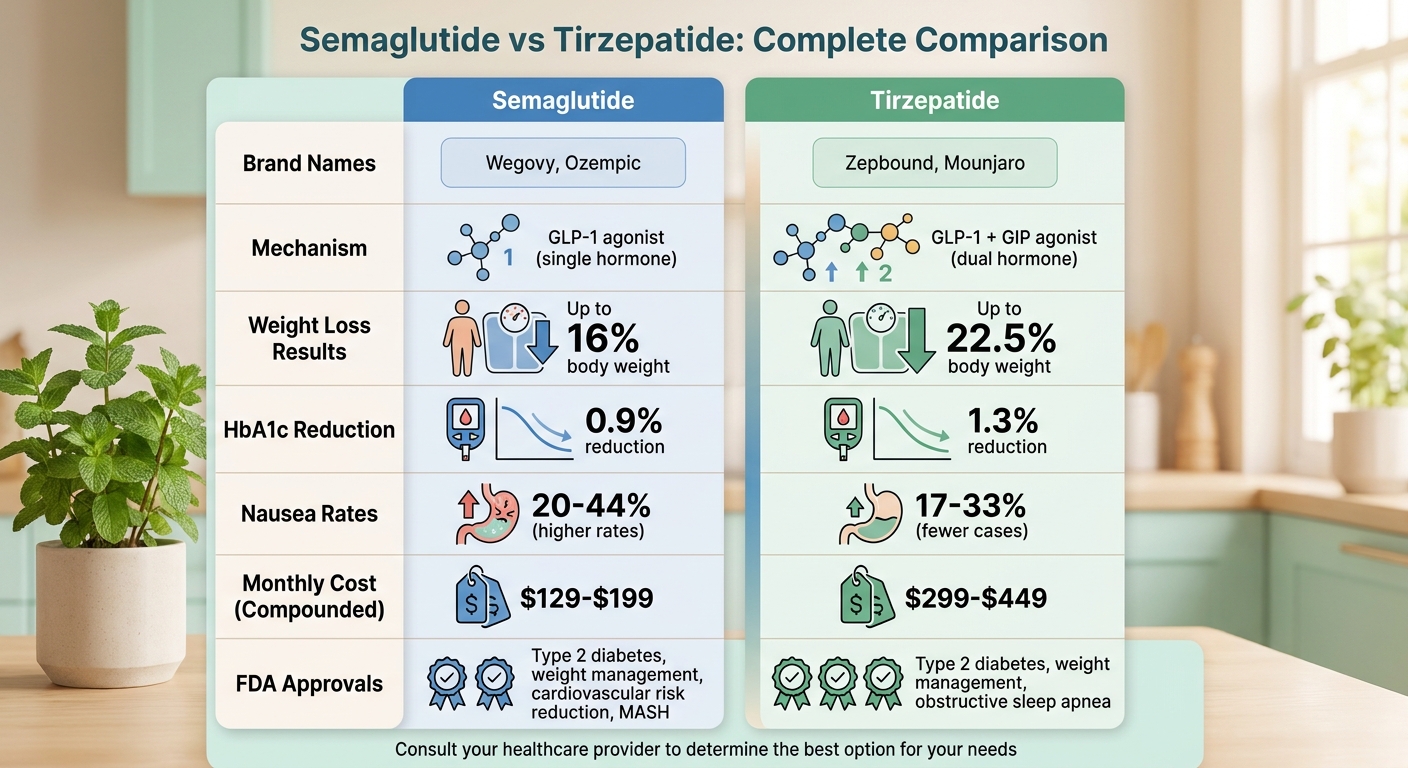 {Semaglutide vs Tirzepatide: Side-by-Side Medication Comparison}
:::
{Semaglutide vs Tirzepatide: Side-by-Side Medication Comparison}
:::
Comparing Semaglutide vs Tirzepatide for Weight Loss in Adults with Obesity: JAMA Study
::: @iframe https://www.youtube.com/embed/hMRt_S5oHnE :::
sbb-itb-11b749a
How These Medications Work
Both Semaglutide and Tirzepatide are designed to mimic hormones your gut naturally releases after eating, but they work in distinct ways. While Semaglutide targets a single hormone pathway, Tirzepatide activates two. These differences in their mechanisms help explain the varied outcomes in weight loss and blood sugar management.
Semaglutide: Single-Hormone GLP-1 Agonist
Semaglutide works by mimicking GLP-1, a hormone released after meals [4]. It binds to GLP-1 receptors in the brain to promote feelings of fullness, which helps reduce calorie intake [4][3]. Another key action is slowing down how quickly food leaves the stomach, keeping you feeling satisfied for longer [4].
For blood sugar control, Semaglutide stimulates the pancreas to release insulin, but only when glucose is present. This targeted approach lowers blood sugar levels while reducing the risk of hypoglycemia [4]. Clinical trials have shown that this single-pathway mechanism leads to an average HbA1c reduction of 0.9% [3] and weight loss of about 14.9% over 68 weeks [4].
Tirzepatide: Dual-Hormone GLP-1 and GIP Agonist
Tirzepatide takes a dual-action approach by activating both GLP-1 and GIP receptors [4]. While GLP-1 focuses on satiety and slowing digestion, the addition of the GIP pathway enhances insulin signaling and energy regulation, improving metabolic balance [3]. This combined action helps manage energy use and boosts insulin sensitivity [4][3].
The results from clinical trials highlight the impact of this dual mechanism. Tirzepatide achieved an average HbA1c reduction of 1.3% [3] and weight loss of 22.5% over 72 weeks [4]. These stronger outcomes in weight loss and blood sugar control are attributed to its dual-hormone approach. These differences in how the medications work also influence their side effect profiles by medication, which will be explored further in the next sections.
Effectiveness for Weight Loss and Diabetes
Weight Loss Results
Research shows that Tirzepatide outperforms Semaglutide when it comes to weight loss. In a 6-month study involving adults with obesity, participants using Tirzepatide experienced an average weight reduction of 11.15% (27.2 lbs), compared to 8.83% (20.8 lbs) for those on Semaglutide [6]. The difference becomes even more pronounced at higher weight loss milestones.
At the 6-month point:
- 59.0% of Tirzepatide users achieved at least 10% weight loss, compared to 38.0% of Semaglutide users [6].
- 31.2% of Tirzepatide patients reached 15% weight loss, while only 14.0% of Semaglutide users hit this target.
- 11.3% of Tirzepatide users achieved a 20% weight loss goal, compared to just 3.8% of Semaglutide users [6].
In fact, patients on Tirzepatide were 3.24 times more likely to achieve a 15% weight loss compared to those on Semaglutide [7].
| Weight Loss Target (6 Months) | Tirzepatide | Semaglutide |
|---|---|---|
| ≥5% Weight Loss | 85.7% [6] | 75.2% [6] |
| ≥10% Weight Loss | 59.0% [6] | 38.0% [6] |
| ≥15% Weight Loss | 31.2% [6] | 14.0% [6] |
| ≥20% Weight Loss | 11.3% [6] | 3.8% [6] |
These medications don't just help with weight loss - they also play a key role in managing blood sugar levels.
Blood Sugar Control and A1C Reduction
Both Tirzepatide and Semaglutide are effective at improving blood sugar control, but Tirzepatide shows a stronger impact. In a 6-month study, Tirzepatide lowered HbA1c levels by an average of 0.52%, compared to 0.37% for Semaglutide [6]. Additionally, Tirzepatide demonstrated better results in reducing systolic blood pressure, with a drop of 7.32 mmHg versus 5.90 mmHg for Semaglutide [6].
"Individuals with overweight or obesity treated with tirzepatide were significantly more likely to achieve clinically meaningful weight loss and larger reductions in body weight compared with semaglutide." - Debabrata Mukherjee, MD, FACC, American College of Cardiology [7]
Real-world evidence supports these findings, showing that Tirzepatide provides consistent benefits for patients, whether they are new to treatment or transitioning from other therapies [8]. Its dual-hormone mechanism offers clear advantages in both weight loss and diabetes management across a variety of patient groups.
Side Effects: What Patients Experience
Digestive Side Effects Comparison
Both semaglutide and tirzepatide slow down stomach emptying, which can cause similar gastrointestinal issues. Nausea is a common complaint, especially when starting treatment or increasing the dose. Fortunately, these symptoms tend to improve within 4–8 weeks.
Here’s how the two drugs compare when it comes to digestive side effects:
| Side Effect | Semaglutide | Tirzepatide |
|---|---|---|
| Nausea | 20–44% [9] | 17–33% [9][10] |
| Vomiting | 9–24% [9] | 6–16% [9] |
| Diarrhea | 12–30% [9] | 13–25% [9][10] |
| Constipation | 14–24% [9] | 11–21% [9][12] |
| Abdominal Pain | 6–20% [9] | 5–14% [9] |
tirzepatide generally causes fewer cases of nausea and vomiting, particularly at higher doses. For example, at maintenance doses, 13% of tirzepatide users reported vomiting compared to 24% for semaglutide [12]. This difference may be due to tirzepatide’s dual-hormone mechanism, where its GIP component helps ease gastrointestinal discomfort.
To minimize these side effects, try eating 5–6 smaller meals daily, steer clear of high-fat or spicy foods, and stay hydrated. Gradually increasing the dose over 6–8 weeks can also lower the chance of discontinuing treatment by 30–40% [12].
While digestive issues are common, there are other side effects and safety factors worth noting.
Additional Side Effects and Safety
Both medications can cause fatigue, affecting 11–14% of semaglutide users and 8–13% of those taking tirzepatide [9]. Injection site reactions are another possibility, occurring in about 3–7% of patients. Thankfully, these symptoms usually fade after a few weeks.
Tirzepatide has a unique consideration: it may reduce the absorption of oral contraceptives. If you're taking tirzepatide, it’s recommended to use a backup non-oral contraceptive method for 4 weeks after starting treatment or increasing the dose [13].
Although rare, both drugs carry serious risks that require careful monitoring. Pancreatitis, characterized by severe abdominal pain radiating to the back, occurs in fewer than 0.3% of cases [9]. Gallbladder issues, including gallstones, affect roughly 2% of users. Semaglutide is linked to a more than 2.5-fold increased risk of gallbladder problems, while tirzepatide does not show a notable increase in such events in some studies [11]. Severe vomiting or diarrhea can also lead to dehydration and kidney issues, so staying hydrated is crucial [9][10].
Both medications come with an FDA Black Box Warning about thyroid C-cell tumors based on animal studies. They are not recommended for individuals with a personal or family history of Medullary Thyroid Carcinoma or Multiple Endocrine Neoplasia syndrome type 2 [13][10]. Discontinuation rates due to side effects range from 5% to 9.8% in major clinical trials [12].
Cost and Access Through Telehealth
Monthly Costs in the United States
In the United States, the monthly cost of compounded semaglutide ranges between $129 and $199, while compounded tirzepatide is priced higher at $299 to $449 - roughly 2 to 2.5 times more expensive [16]. Brand-name medications are significantly pricier, with Wegovy costing around $1,349 per month and Zepbound approximately $1,060 per month [15].
However, direct-to-consumer options have introduced more affordable pricing. As of April 2026, Eli Lilly's LillyDirect program offers Zepbound for just $299 per month through December 2026, presenting a much cheaper alternative to traditional retail channels [14]. Similarly, telehealth providers have stepped in with competitive pricing: in March 2026, Henry Meds offered compounded semaglutide for $149 per month and compounded tirzepatide for $349 per month [14]. For those seeking the lowest price, SkinnyRx stood out in April 2026, offering compounded semaglutide at $129 per month [16].
"If you are paying more than $199/month for compounded semaglutide from a basic telehealth provider... you are overpaying relative to the current market." – Telehealth Ally Editorial Team [16]
Patients with commercial insurance can often find even lower costs through manufacturer savings programs. For instance, Novo Nordisk's savings card can reduce the cost of Wegovy to $0 to $25 per month, while Eli Lilly's card lowers Zepbound to $25 per month for those with insurance coverage. Additionally, Medicare Part D caps the out-of-pocket cost for covered GLP-1 medications at $35 to $50 per month as of 2026 [16].
Affordability plays a key role in treatment decisions, and these evolving pricing strategies make it easier for patients to access these medications through telehealth platforms.
Getting These Medications Through Telehealth
Telehealth platforms generally offer two pricing structures:
- All-in pricing: Includes consultation, medication, and shipping for cash-paying patients.
- Split-pricing: Separates membership fees from medication costs, which can help patients utilize insurance benefits [14][15].
To simplify the process, Telehealth Ally provides comparison tools that allow users to filter providers based on price, consultation type, and insurance acceptance. This is particularly useful since 80 to 85% of commercial insurance plans cover GLP-1s for type 2 diabetes, but only 40 to 50% cover them for obesity treatment alone [17].
"The market is shifting from compounded-dominant to brand-accessible." – Sarah Chen, Lead Health Editor, Telehealth Ally [14]
For those considering brand-name medications, checking insurance coverage is essential. Manufacturer coupons can sometimes make brand-name options more affordable than compounded alternatives. Additionally, 40 to 60% of GLP-1 insurance appeals are successful when supported by a letter of medical necessity - a service that many split-pricing telehealth providers assist with [15].
FDA Approval and Safety Information

FDA Approval Status and Patient Monitoring
FDA approvals and safety guidelines highlight the differences and benefits of these treatment options. Ozempic (semaglutide) is approved for type 2 diabetes and reducing cardiovascular risks in adults with diabetes and established heart disease [13]. Wegovy (semaglutide) is approved for chronic weight management in adults and children aged 12 and older with obesity, and in August 2025, it received accelerated approval for treating noncirrhotic MASH with moderate to advanced fibrosis [13]. Additionally, Wegovy HD gained approval in March 2026 for adults needing further weight loss after tolerating the standard 2.4 mg dose [13].
Mounjaro (tirzepatide) was approved in May 2022 for blood sugar control in adults and children aged 10 and older with type 2 diabetes [5]. Later, Zepbound (tirzepatide) was approved in November 2023 for chronic weight management in adults with obesity or overweight and at least one weight-related condition [19]. By December 2024, Zepbound became the first medication specifically approved to treat moderate to severe obstructive sleep apnea in adults with obesity [13].
Both medications carry a Boxed Warning about the risk of thyroid C-cell tumors. They are not recommended for patients with a personal or family history of medullary thyroid carcinoma or Multiple Endocrine Neoplasia syndrome type 2 [19][20]. Regular monitoring is critical: healthcare providers should check HbA1c levels and body weight every three months and watch for signs of pancreatitis, gallbladder issues, kidney problems, and worsening diabetic retinopathy [5][19]. Additionally, patients should be screened for new or worsening depression or suicidal thoughts [19][20].
"Obesity and overweight are serious conditions that can be associated with some of the leading causes of death such as heart disease, stroke and diabetes." – John Sharretts, M.D., Director of the Division of Diabetes, Lipid Disorders, and Obesity, FDA [19]
One important note: tirzepatide can interfere with the effectiveness of oral birth control. Patients are advised to use non-oral contraceptive methods or add barrier protection for four weeks after starting or increasing the dose [5].
These safety considerations provide a foundation for understanding the cardiovascular benefits of these treatments.
Heart Health Benefits
Beyond their regulatory approvals, both medications offer noteworthy cardiovascular benefits. In the SELECT trial, Wegovy reduced major adverse cardiovascular events (MACE) by 20% over a median of 40 months [1]. Specifically, it lowered the risk of heart attack (hazard ratio 0.81) and stroke (hazard ratio 0.84) compared to other diabetes treatments [21].
For tirzepatide, cardiovascular research is ongoing through the SURPASS-CVOT trial, and early findings are encouraging [21]. A 2025 study published in Nature Medicine compared 297,842 patients and found that both medications had a 1-year MACE risk of 1.3%, indicating similar cardiovascular protection in clinical use [21]. In October 2025, Cleveland Clinic researchers analyzed data from 31,000 adults with liver disease, obesity, and type 2 diabetes. They found that tirzepatide was linked to significantly lower risks of MACE and heart failure exacerbations compared to semaglutide in this group [22].
"We have more and more evidence that these medications do work - not only to help with liver-related outcomes, but also with cardiovascular outcomes. And now we have evidence that a dual agonist is better than a single agonist." – Dian Chiang, MD, MPH, Hepatologist, Cleveland Clinic [22]
Tirzepatide may have an edge in heart failure outcomes, likely due to its dual receptor activation and stronger weight loss effects [21]. The SURMOUNT-5 trial also showed that tirzepatide led to significantly greater improvements in both systolic and diastolic blood pressure compared to semaglutide after 72 weeks [23].
Which Medication Is Right for You
When deciding between semaglutide and tirzepatide, it comes down to your personal health goals, financial situation, and medical history. Both medications are effective, but they cater to different needs.
Semaglutide might be the better choice if you have heart disease or chronic kidney disease. Research backs this up: the SELECT trial showed a 20% reduction in major cardiovascular events, while the FLOW trial reported a 24% decrease in kidney-related events [2]. Plus, semaglutide offers a daily oral option (Oral Wegovy or Rybelsus) for those who prefer pills over weekly injections [1][24]. With its longer track record, it’s a well-established option with proven safety.
Tirzepatide could be ideal if significant weight loss is your main goal. In clinical trials, tirzepatide led to an average weight loss of 20.2%, outperforming semaglutide's 13.7% over 72 weeks [25]. It’s also highly effective for reducing A1C, with reductions between 2.0% and 2.3%, compared to semaglutide’s 1.5% to 1.8% [2]. Additionally, tirzepatide is FDA-approved for treating moderate to severe obstructive sleep apnea in adults with obesity [13].
"Choosing between semaglutide and tirzepatide is not about selecting the strongest option. It is about choosing the option you can stay consistent with." – Shayna Macklin [3]
Cost is another crucial factor. Check the earlier cost breakdown to understand pricing and insurance options. Insurance coverage can significantly lower your monthly expenses, and Medicare's Bridge Program, starting in July 2026, will cap costs at $50 per month for both medications [1].
Dosing preferences and availability also matter. As of April 2026, 113 telehealth providers offer semaglutide, slightly more than the 107 offering tirzepatide [18]. Take these factors into account, and consult your healthcare provider to find the best fit for your cardiovascular health, weight loss goals, and budget.
FAQs
::: faq
How do dosing and dose increases work for each medication?
Both semaglutide and tirzepatide are introduced at low doses and gradually increased over time. This approach helps improve their effectiveness while minimizing side effects.
- Semaglutide usually starts at 0.25 mg per week and may be increased to 1 mg or higher, depending on the condition being treated.
- Tirzepatide begins at 2.5 mg per week, with the potential to go up to a maximum dose of 15 mg.
The specific dose adjustments depend on how well the individual responds to the treatment, how tolerable they find it, and any side effects they experience, such as nausea. :::
::: faq
Can I switch from semaglutide to tirzepatide (or vice versa) safely?
Switching between semaglutide and tirzepatide is generally considered safe, but it’s essential to do so under the guidance of a healthcare provider. Factors like dose adjustments, potential washout periods, and your individual health needs play a key role in ensuring a smooth transition.
Both medications fall under the category of incretin-based therapies, but they work a bit differently. Semaglutide specifically targets GLP-1 receptors, while tirzepatide works on both GIP and GLP-1 receptors, offering a broader mechanism of action. A medical professional will carefully manage the switch, ensuring the correct dosage and closely monitoring for any side effects along the way. :::
::: faq
Which option is more likely to be covered by my insurance for weight loss?
Tirzepatide is increasingly covered by insurance for weight loss, with coverage expanding significantly in recent years due to its specific design for weight management. On the other hand, semaglutide often faces more restrictive insurance policies. Coverage for semaglutide is typically focused on patients with type 2 diabetes and may require prior authorization, particularly when prescribed for weight loss. :::
Related Comparisons
CagriSema vs Tirzepatide (Zepbound): Complete Head-to-Head Comparison
Head-to-head comparison of CagriSema vs tirzepatide (Zepbound). REDEFINE 4 showed CagriSema did NOT meet non-inferiority (22.2% vs 25.3%). Mechanism, dosing, side effects, pricing, and who should choose which.
Compounded Semaglutide Providers 2026: Who Still Offers It, Pricing & Safety
Complete roundup of every telehealth provider still offering compounded semaglutide in 2026 — pricing comparison, safety considerations, FDA enforcement status, and when to switch to brand.
Compounded Semaglutide vs Brand Wegovy: Is It Worth It?
Compounded semaglutide vs brand Wegovy comparison covering safety, FDA regulation, cost ($149 vs $1,349/mo), efficacy considerations, and who should choose each option.
Related Guides
GLP-1 for Weight Loss AND Type 2 Diabetes: The Dual-Indication Advantage
If you have both obesity and type 2 diabetes, GLP-1 medications can treat both conditions simultaneously — and the diagnosis you use to prescribe under can dramatically affect your insurance coverage, out-of-pocket cost, and medication options.
ProvidersBest Weight Loss Injection 2026: Wegovy HD, Zepbound, and Every Option Compared
Every FDA-approved weight loss injection compared for 2026. Wegovy HD 7.2mg, Zepbound, Wegovy 2.4mg — efficacy, pricing, side effects, and who each is best for. Plus oral options (Oral Wegovy, orforglipron pending FDA approval).
Patient GuidesWeight Loss Shots 2026: Every Injectable Medication Compared
Every weight loss injection compared in one place — Wegovy, Zepbound, Saxenda, Ozempic, Mounjaro, and compounded options. How they work, how much weight you lose, what they cost, what the injection actually feels like, and how shots compare to pills.
Patient GuidesBest Weight Loss Medication 2026: Every FDA-Approved Option Ranked
Every FDA-approved weight loss medication compared in one place — GLP-1s (Wegovy, Zepbound, orforglipron), non-GLP-1 pills (Contrave, Qsymia, phentermine, Xenical), and off-label options (Ozempic, metformin). Efficacy, pricing, side effects, insurance, and how to choose.
News & ResearchGLP-1 Cost Calculator
MedicationsTirzepatide: Complete Guide to Mounjaro, Zepbound & What You Need to Know
Everything about tirzepatide in one place: how it works, Mounjaro vs. Zepbound, dosing protocols, weight loss data, costs, side effects, and where to access it.
Get weekly GLP-1 pricing updates
We track prices so you don't have to.
No spam. Unsubscribe anytime.
Ready to Find Your Match?
Answer a few quick questions and we’ll match you with the right provider and medication for your goals.